The Gouge as Lens Plan: Why 2026 Indie Shorts Are Previsualizing in Wood
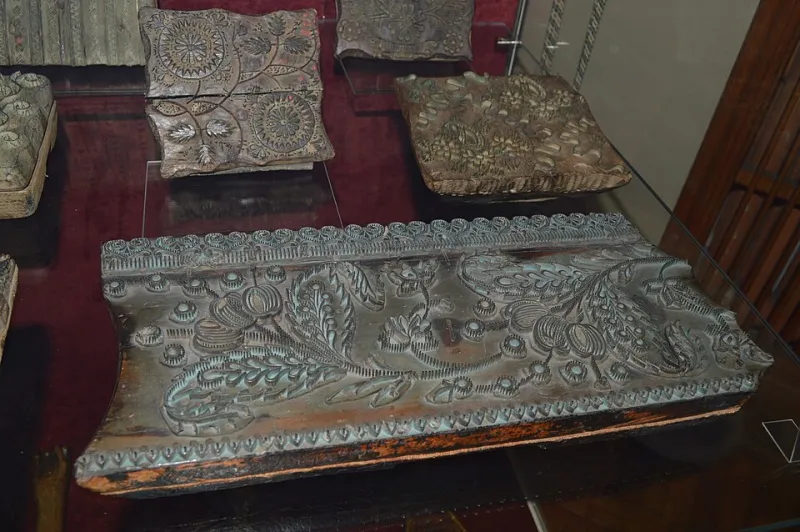
Photo: Лапоть, CC0, via Wikimedia Commons
In the preproduction packets circulating through American micro-cinemas this autumn, one artifact keeps surfacing: a carved block, roughly four by six inches, pulled in a single ink onto thin kozo paper, registration marks intact. It is not merchandise and not a poster. It is the shot plan.
Across a small but visible cluster of 2026 short productions — among them Marisol Vance’s Salt Lick, photographed on the alkaline flats of eastern Oregon, and Owen Pfaff’s The Tenancy, staged entirely inside a Baltimore row house — the carved key frame has displaced both the mood board and, in several cases, the drawn storyboard. Directors are carving three to nine images before a camera is rented, and what survives the gouge becomes the film’s visual argument rather than its decoration.
The proof arrives before the shot list
In Vance’s packet, the first block is not a pretty picture; it is a decision about where the ground meets the sky. She cut the horizon at the upper third with a 3 mm U-gouge and cleared the foreground water with a broad flat, leaving a single unprinted strip to stand for the sun’s reflection. The gaffer on Salt Lick received that print — not a lighting diagram, not a reference still. The ratio of cleared paper to black line became the ratio of key to fill for the film’s first two days.
What the tool will not do
A gouge cannot render a soft falloff. A block cannot hold a dissolve. One ink means every value in the frame must be argued into existence through the density of lines, the width of a clearing, the pressure of the baren. On the productions examined here, these are not limitations to be worked around; they are the point. Compositions that cannot be read in a single impression get revised at the bench, before twenty crew members stand in a field waiting on the light.
Pfaff puts it plainly: “The block doesn’t let you hedge. If the figure isn’t readable in one pull, it won’t be readable on set either. You lose a week of arguing with a monitor.”
The consequence is a harder silhouette and a more deliberate frame. In The Tenancy, blocking was fixed to preserve a single vertical mass — a doorframe, a coat, a person — in each setup, because the carved plan could hold only one dominant dark shape per image. Actors were moved in service of that shape, not the other way around.
Grain as a depth cue
Printers know that paper texture is not neutral. It takes ink unevenly, and the eye reads that unevenness as atmosphere. Cinematographers working from blocks have begun translating fiber into depth: rough kitakata implies haze and a longer lens; smooth gampi implies clarity and a wider one. On Salt Lick, the decision to shoot the exterior flats on a 50 mm rather than a 35 mm came directly from a proof pulled too dry, its grain standing up like distance. The cinematographer kept the flawed pull taped to the matte box for the length of the shoot.
The edit inherits the tempo of the knife
The most consequential carryover may be temporal. Directors who carve their own plans report that the time a block takes to clear becomes a rough proxy for how long a shot should be held. A four-hour block — dense foliage, a crowd, a face worked in three stages — tends to survive into the assembly as a nine- or ten-second hold; a twenty-minute block, cleared in a few decisive strokes, tends to become a two-second cut. Editors are not told this rule. They discover it in the footage, because the shot was staged at the speed the tool allowed.
The edition as a discipline on setups
Several productions now edition their preproduction blocks, pulling a fixed number of impressions and treating edition size as a cap on setups. A director who can afford forty pulls plans forty shots. The constraint is financial as much as aesthetic: paper, ink, and studio hours cost money that would otherwise go to a second camera day. But the effect on the finished short is structural. Scenes consolidate. Coverage shrinks. The film acquires the density of something that has been edited before it was shot.
A handful of companies have begun selling proof sets at screenings — a practice distinct from the poster economy and one that raises its own questions about how much process an audience should be sold. That debate belongs elsewhere. What matters here is that the ledger shapes the film.
What the constraint costs
None of this is free. Carving is slow, and slow previsualization punishes the director who thinks best on set. The method also flatters a certain temperament — patient, graphic, fond of the bold gesture — and can produce shorts that look like illustrations of themselves, all silhouette and no weather. The productions that avoid the trap treat the block as an argument to be tested rather than a look to be matched. When the proof and the location disagree, the location wins; the block is revised, sometimes on the second day of shooting, sometimes abandoned altogether.
Still, the appeal is legible. In a year when American short films compete for the same small rooms and the same short attention, a carved plan offers something a deck cannot: proof that a decision was made by hand, under pressure, with a tool that could ruin the sheet. The 2026 festival slate will show whether the method travels beyond the studios that invented it. For now, the blocks are being cut, and the cameras are waiting on them.