Before the Beam Lands: How Projection Surfaces Become Co-Authors in American Experimental Shorts
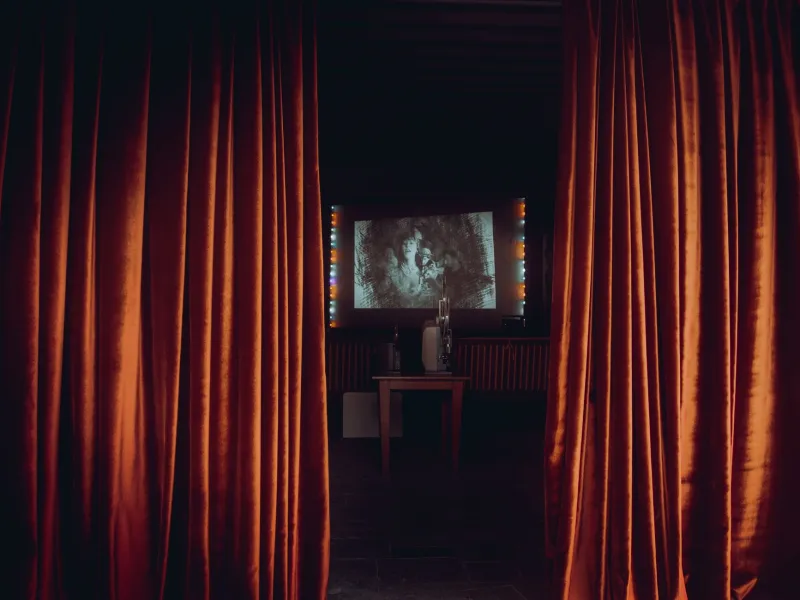
The projector is usually described as the final instrument in the chain: lens, lamp, gate, beam. But in a small but persistent corner of American experimental film, the instrument after the instrument is the wall itself. For these filmmakers, the screen is not a blank receptor. It is a substrate with a grain, a rate of absorption, a color temperature, and a cost. To choose it is to make a formal decision as consequential as choosing a stock, a developer, or a cut.
As of 2026, this practice remains modest in scale but increasingly visible in micro-cinemas and artist-run screening rooms. It is not a return to handmade projection in the nostalgic sense. It is closer to the logic of relief printing: the image is not simply placed on a surface; it is negotiated with one. A dense black may sit on top of linen. A pale wash may sink into unprimed canvas. A seam in recycled paper may become a horizon line by accident, then by design.
The Substrate Is a Decision
The conventional projection screen is engineered for neutrality. It aims to reflect evenly, minimize texture, and disappear. Experimental filmmakers who work with surface choice tend to reverse those priorities. They ask what the material will do to the image, and what the image will do to the material. Does the weave interrupt a slow dissolve? Does the paper pull light away from the edges of the frame? Does painted drywall give a short a domestic architecture that a portable screen would erase?
That reversal has a practical vocabulary. Filmmakers speak of tooth, absorbency, stretch, seam behavior, and reflectance. They test clips before a shoot or a premiere. They compare how a gray reads on cotton duck versus how it reads on a primed theatrical surface. They learn that a surface with too much texture can make a quiet composition look busy, and that a surface with too little can make a deliberately rough image feel antiseptic. The screen becomes a collaborator with veto power.
Three Filmmakers, Three Surfaces
Mara Ellison, a Brooklyn filmmaker working in short experimental nonfiction, began using unprimed canvas after a gallery projection left her film looking flatter than the print tests had promised. The canvas was not a improvisation. Ellison now buys by the roll, stretches sections on modular frames, and tests each batch under the same lamp as her final venue. Her current work depends on the way unprimed cotton drinks light. Highlights lose a hard edge; shadows gain a soft, fibrous border. The surface does not reproduce the image so much as temper it.
Devin Ortiz, based in Chicago, works with recycled paper mounted to rigid panels. The paper is selected for its tooth, not its whiteness. Ortiz prefers sheets with visible inclusions and slight tonal variation, because those irregularities create a low-level animation when the projector beam moves across the field. He accepts the fragility. A paper surface can dent, curl, or tear. For Ortiz, that vulnerability is part of the exhibition: the audience is looking at an image that is also an object under strain.
Ruth Kwan, who splits her time between Los Angeles and Portland, paints directly onto drywall. The wall is prepared, sanded, and sometimes left with the seams visible. Kwan treats the architecture as a plate. Her shorts are often shown in rooms where the drywall is already part of the space, so the projection does not arrive as a rectangle imposed on a neutral field. It arrives as a mark on a wall that has its own history of repair. The surface is not portable, and that immobility is the point.
The Programmer’s Problem
For micro-cinema programmers, surface choice is both an aesthetic invitation and a logistical bill. Celia Ward, who programs at The Lantern, a small screening room in Chicago, has begun asking filmmakers for surface specifications alongside their exhibition formats. She keeps a modest surface library: a few stretched canvases, a roll of linen, and several paper panels in storage. The library is not a full solution. It is a way to reduce the friction between a filmmaker’s ideal and a venue’s reality.
Ward argues that surface choice changes the audience’s attention. A textured screen makes the projection feel less like a window and more like a printed page held at an angle. That shift can be productive for experimental work, but it can also fatigue viewers if every short in a program insists on the same material drama. Her curation now balances surface-heavy pieces with works designed for conventional screens, not to neutralize the program but to give the eye intervals.
Jonah Pike, who runs the Aperture Room in Austin, approaches the same problem from the economics side. A venue can invest in reusable surfaces, but storage, cleaning, insurance, and transport all add cost. Touring a paper-based installation is particularly difficult. Pike has found that some filmmakers prefer to ship instructions rather than materials, trusting local crews to prepare a surface to specification. That solution lowers freight costs but raises the stakes on venue labor and consistency. The screen becomes a contract between maker and exhibitor.
The Economics of Tooth
Surface choice is often described as an aesthetic preference. In practice, it is a budget line. Raw canvas costs money, and so does the labor to stretch it. Paper surfaces are cheaper per sheet but more fragile across a tour. Painted drywall can be inexpensive in materials and expensive in time, especially when a venue must repair a wall after a run. Micro-cinemas absorb some of these costs as curatorial overhead; filmmakers absorb others as production design.
That economic reality keeps the practice close to its roots. It flourishes where filmmakers and exhibitors already share equipment, labor, and space. It is less suited to the circuit of festivals that require a single DCP and a neutral screen. But the limitation is also a filter. The films that use surface choice tend to be made for rooms where the material conditions are visible, not hidden. The audience is not asked to forget the apparatus. It is asked to read it.
A Collaborative Material
At Xylograph Films, the interest in carved image and projected light makes this trend legible. A woodblock does not accept ink passively; it resists, channels, and records the pressure of the cut. A projection surface does something similar. It receives the beam, but it also answers back. The current generation of American experimental filmmakers is not simply choosing prettier screens. It is asking what the screen can author. The answer, increasingly, is part of the film.