The Projector as Press: Live Film-Scratching and the Micro-Cinema Turned Open Workshop
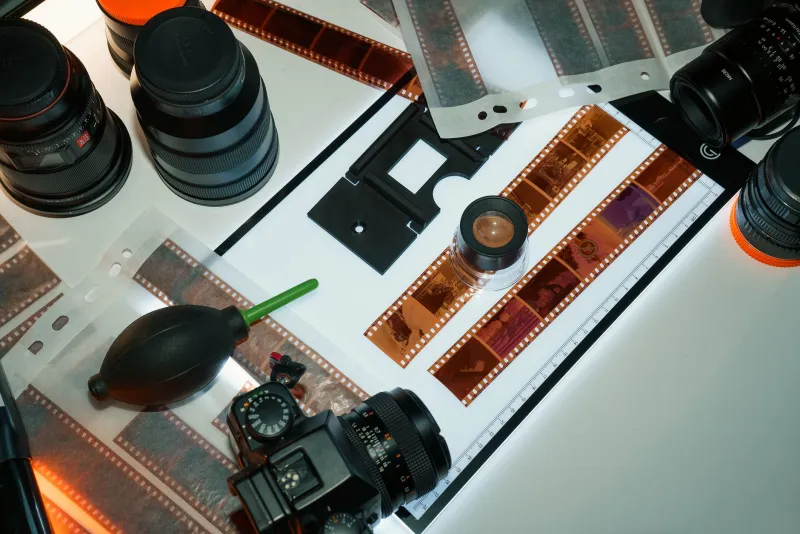
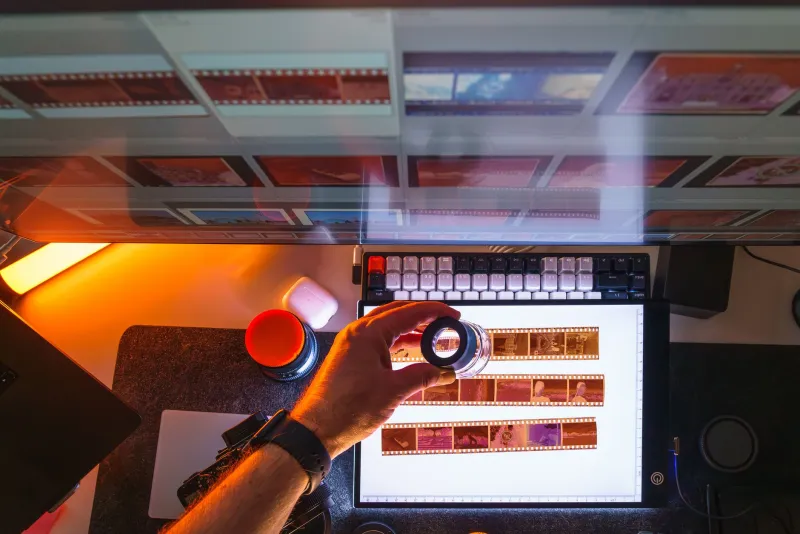
The house lights do not go all the way down. That is the first clue that something other than a conventional screening is about to take place. On a table beside the projector, a strip of clear 16mm leader is taped to a cutting mat. Beside it sit a razor blade, an awl, a small gouge, a bottle of India ink, and a roll of splicing tape. The audience is close enough to see the tools. When the artist begins to scratch directly into the emulsion, the sound is faint but unmistakable: a dry, granular scrape that carries through the room before the image ever reaches the screen.
This is the live carved-film performance, a format that has moved from festival side program to a recurring feature of American micro-cinemas. The appeal is not merely novelty. It is procedural. The audience watches a film come into being at the same speed as the hand that makes it, then watches that same material pass through the projector as a kind of moving proof sheet. The theater becomes a workshop, and the screen becomes the press.
A Working Surface, Not a Finished Object
Most live carved-film performances begin with clear or black leader, sometimes with found footage that has been stripped of its image. The artist may work on a long loop, a short strip, or a series of frames prepared in advance and altered in public. The tools are ordinary: blades, needles, sandpaper, bleach, markers, hole punches, and the small carving gouges borrowed from printmaking. What matters is directness. Every mark is made at the scale of the frame, and every frame is small enough to hold between thumb and forefinger.
The technique has deep roots in cameraless cinema. Len Lye scratched and painted directly on film in the 1930s; Harry Smith and Stan Brakhage later treated the strip as a surface rather than a recording medium. The contemporary live format extends that lineage by making the labor visible. In a darkened theater, the artist becomes a performer of small gestures. The audience does not simply receive an image; it watches an image being dug out of the material.
At venues such as Light Industry in Brooklyn, the Nightingale in Milwaukee, Echo Park Film Center in Los Angeles, and Chicago Filmmakers, the format tends to arrive with a deliberate looseness. A performer may narrate the process, pause to change tools, or invite a volunteer to hold a strip against a light. The atmosphere is closer to an open studio than to a premiere. That informality is not incidental. It is the point.
The Circuit and Its Performers
The artists working this circuit are not a single school. Some come from experimental film and direct animation; others from printmaking, sound art, or zine culture. One Brooklyn-based performer works almost exclusively with black leader, cutting away the emulsion to produce white line drawings that flicker like woodcut proofs. A West Coast artist favors clear leader and colored inks, building dense, overlapping fields that behave like stained glass when projected. A third treats the projector itself as an instrument, varying the loop length and lamp intensity so that the same strip reads differently from one pass to the next.
What unites them is a willingness to work in public without hiding the seams. The performance is not a demonstration of mastery. It is a negotiation with materials that refuse to behave. A gouge slips. A splice fails. Ink bleeds beyond the frame line. The audience sees the correction, and the correction becomes part of the event. In this sense, the live carved-film performance is less about the perfection of a print than about the credibility of the process.
Micro-cinemas are well suited to this. Their seating is limited, their audiences are self-selected, and their programming often favors work that can be discussed in the room rather than merely consumed. A live performance gives these venues a way to activate their space without abandoning the intimacy that defines them. It also gives artists a rare opportunity to test material in front of an audience before committing to a final print.
The Tension Between Event and Artifact
The most interesting problem raised by live carved-film performance is the status of the object left behind. A screening is ephemeral by nature, but a carved strip is not. It can be rewound, stored, re-projected, or sold. Some performers lean into this tension by making the live strip the master and refusing to edition it. Others produce a small run of prints after the event, each one slightly different because the hand cannot repeat itself exactly. The result is a hybrid: part performance document, part multiple, part relic.
This is where the print-shop analogy becomes more than a metaphor. In relief printing, the block is carved, inked, and pressed; the edition records the block but never exhausts it. Live carved film works the same way. The performance is the pulling of the proof, and the surviving strip is the block. Collectors may want the artifact, but the artifact is only legible if one imagines the room, the tools, and the hand that made it.
For American experimental cinema, that is a useful corrective. The field has spent years arguing over preservation, restoration, and the authority of the final cut. Live carved-film performance reminds us that authority can be temporary and that craft can be public. The screen does not have to conceal its own manufacture. It can show the scratch, the splice, and the smear of ink, and still hold an audience.
Xylograph Films follows this work because it sits at the intersection of two disciplines the site cares about: the carved surface and the projected image. The live performance does not resolve the tension between ephemeral event and collectible artifact. It keeps that tension visible, which is exactly what a workshop is for.