The Slipped Layer: Misregistration as Method in American Experimental Shorts
In the current cycle of American experimental short film, one of the most legible signatures is a deliberate failure of alignment. Red separations trail blue. Cyan sits a hair to the left of the key image. A registration cross remains visible in the corner of a frame, not as an oversight but as a punctuation mark. These are not the artifacts of a rushed transfer or a damaged print. They are decisions, repeated across a small but visible network of filmmakers who want the moving image to behave less like a clean digital file and more like a sheet pulled from a press.
For Xylograph Films, the appeal is not difficult to name. The company’s own vocabulary—cinema carved in ink and light—assumes that the image has a surface, a pressure, a history of contact. Misregistration makes that assumption visible. It turns color into a set of plates that can be nudged, and it turns the frame into a place where layers can fail to kiss.
The Registration Mark as Dramaturgy
The lineage is longer than the current festival cycle. Multiple-block woodcut and screenprint have always treated registration as a negotiation: the black key block holds the drawing, while color blocks add weight, atmosphere, or interruption. When those blocks slip, the image gains a tremor. Risograph printing in the 1980s made a similar slip part of its ordinary charm, with each pass of ink introducing slight offsets and uneven coverage. Optical printing and color separation in film carried the same possibility into moving images, though commercial cinema usually spent considerable effort hiding it.
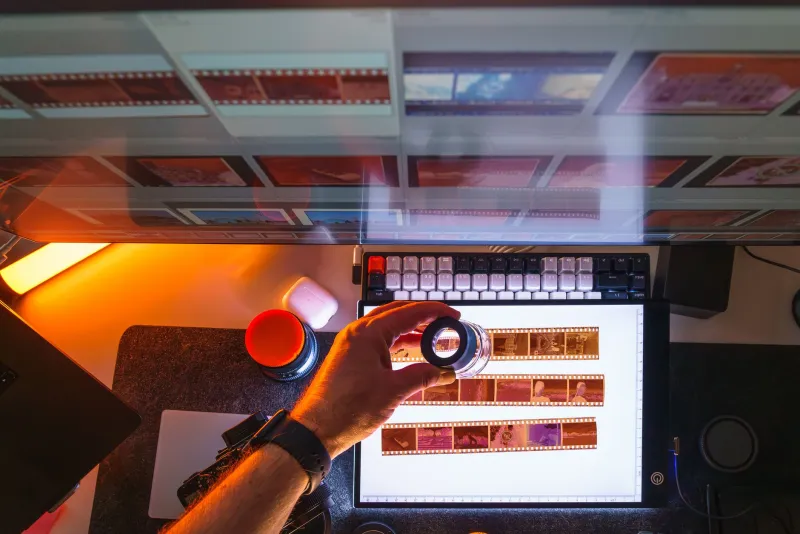
What has changed in 2026 is not the availability of the technique but the willingness to let it stand. Desktop tools make perfect alignment the default. A generation of filmmakers raised on those defaults has begun to reintroduce friction by hand: scanning printed separations, rephotographing color records, offsetting channels in compositing, or building registration marks into the design of a shot. The mark is no longer residue. It is score.
Three Techniques, One Attitude
The work is varied, but three approaches recur. The first is channel offset: red, green, and blue records are displaced by a few pixels or a few frames, so that edges bleed into color fringes and the eye must work to assemble a stable image. The second is separation scanning: filmmakers print color separations on paper, scan them back in, and let the grain and slight misalignment of the physical sheets enter the digital file. The third is graphic registration: visible crosses, crop marks, and color bars are composed into the frame, turning the apparatus of printing into part of the mise-en-scène.
These methods are not interchangeable, and the strongest work treats them as arguments rather than filters. A preset that mimics misregistration tends to look like a costume. A film built from actual displaced layers tends to feel structural, because the misalignment organizes time as well as color. When a red plate arrives late, the image is not simply imperfect; it is late.
Conversations with Three Filmmakers
Mara Ellison, a Brooklyn-based filmmaker working with 16mm and digital intermediates, describes her recent short “Red Plate, Blue Plate” (2026) as a study in “the second block”—the color layer that arrives after the drawing and changes its meaning. Ellison exposes color separations, rephotographs them, and then allows the registration to drift by a few frames. “I treat the red channel like a second woodblock,” she says. “It should not merely fill in the drawing. It should press against it.”
Devin Cho, working in Los Angeles, comes to misregistration through printed matter. Cho scans risograph prints and uses their uneven ink coverage as source material for animated sequences. In “Three Passes on a Dry Field” (2026), the same landscape is printed three times in different color combinations, each pass slightly out of joint. “If the layers kiss too neatly, the image stops breathing,” Cho says. “The slip is where the paper and the machine disagree. I want that disagreement on screen.”
In Chicago, Ruth Calder treats registration marks as narrative devices. Her short “Offset Hours” (2026) follows a night worker through a building whose floors are rendered as separate color plates. A visible cross in the corner of the frame changes position as the character moves, as if the film itself were being reprinted on the fly. “The mark tells you where the image thinks it is,” Calder says. “When it moves, the image loses confidence. That is useful dramatically.”
Why the Slipped Layer Suits the Moment
The broader context matters. American audiences for experimental shorts are small but attentive, and the micro-cinema and festival circuits have become adept at presenting work that asks to be read as much as watched. At the same time, the tools of production have become almost frictionless. Misregistration is one way to reintroduce the evidence of labor without returning to expensive analog workflows. It is a cost-effective texture, but it is also a philosophical position: the image should show the conditions of its making.
There is a risk, of course. Misregistration can become a decorative tic, a way of signaling indie credibility without doing structural work. The difference is whether the slip participates in the film’s argument. In the strongest recent shorts, color is not simply out of joint; it is out of joint for a reason. The offset creates tension between what is seen and what is withheld.
Five Recent Shorts Where the Color Is Out of Joint
“Red Plate, Blue Plate” (Mara Ellison, 2026) uses a drifting red separation to make a domestic interior feel unstable without resorting to camera movement. “Offset Hours” (Ruth Calder, 2026) turns registration marks into a kind of clock. “Three Passes on a Dry Field” (Devin Cho, 2026) builds landscape animation from scanned risograph passes, each one slightly late. “Registration Prayer” (Ana Ruiz, 2026) places color bars and crop marks in the same frame as a portrait, so that the subject appears to be printed rather than photographed. “The Clean Version” (Peter Vale, 2026) begins with perfect alignment and then, over twelve minutes, allows the layers to separate, as if the film were slowly losing its composure.
The Difference Between Texture and Tic
What distinguishes these works from mere style is their patience. Misregistration is not a single gesture but a duration: the eye keeps trying to resolve the image, and the image keeps refusing full resolution. That refusal is close to the experience of looking at a woodcut or a misprinted poster, where the surface holds the viewer in a state of active adjustment. For American experimental shorts in 2026, the slipped layer is not a retreat from precision. It is a more demanding kind of precision—one that knows exactly where the plates should meet, and chooses, for a moment, to let them miss.