Five Print Shops Where the Press Room Quietly Became a Film Crew
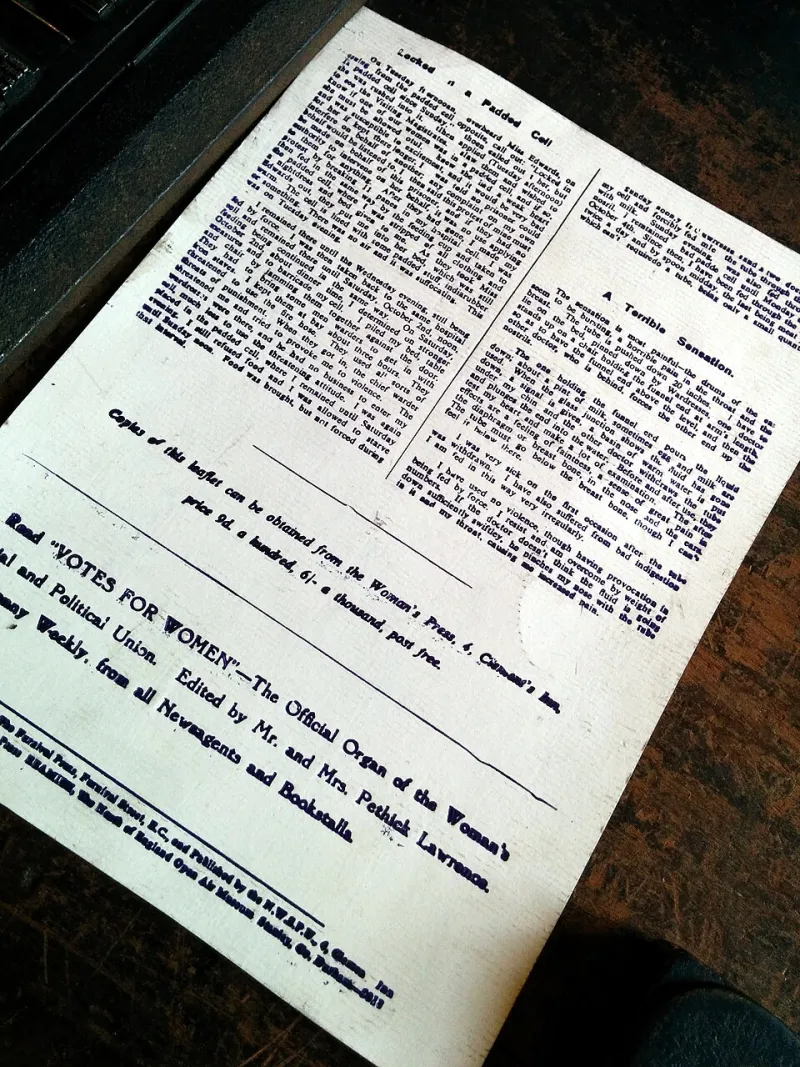
Photo: Cory Doctorow from London, UK, CC BY-SA 2.0, via Wikimedia Commons
Community print shops are not, on paper, film organizations. They rent press time by the hour, teach letterpress and relief classes, and survive on memberships and small grants. But a survey of experimental short credits from the past two years turns up the same shop names in the same unlikely places: camera department, props, titles, color. What follows is not a ranking — it is a mapping of five rooms where the press and the camera have started sharing a schedule.
1. Pullman & Daughters, Providence, Rhode Island
The shop occupies the ground floor of a former textile building and runs on a 1911 Chandler & Price platen press that members treat with the reverence usually reserved for a camera body. Ines Pullman, who took over the business from her mother, photographed Field Notes from a Cold Press, a nine-minute short shot entirely in the shop’s workroom.
What Pullman brought to the camera was registration discipline. “You learn to lay a sheet the same way four hundred times,” she said. “That is operating.” Crews who have worked with her describe a set where the marks are taped, the frame is checked twice, and nothing is rushed to make a sunset. The shop’s members now rotate through camera assistant roles on two or three local shorts a year.
2. The Halftone Co-op, Detroit, Michigan
The co-op’s contribution is usually invisible until you know where to look: set dressing that behaves like printed matter. For Grain Elevator, a short staged in a decommissioned silo, members built a twelve-foot press-bed wall out of salvaged furniture and inked paper, then lit it so the texture carried into the background of every wide shot.
Tyree Boone, a co-op member who now works regularly as a props lead, argues that the skill is one of scale. “A printmaker thinks in layers because the block forces you to,” he said. “Foreground, middle, background — you build the set the same way. You just have more room to be wrong.”
3. Quoin & Bevel, Minneapolis, Minnesota
The shop’s letterpress department has become a title house. For The Long Pull, a fourteen-minute short about a family of printers, the filmmakers commissioned hand-set intertitles rather than digital cards, then shot them under a macro lens at exposure times calibrated to the paper’s tooth.
Members describe the work as a negotiation between kerning and shutter. A title that reads cleanly at arm’s length can turn to mud on a small screen, so the shop now runs a projection test for every card — printing, shooting, projecting, revising. It is slow. It is also the reason the film’s titles survived a badly calibrated projector at a festival last spring without losing a word.
4. Overrun Press, Oakland, California
Post-production is where Overrun’s influence is most measurable. Dara Okafor, a member who scans and color-matches proofs for artists’ editions, has been hired by three experimental shorts this year to build what she calls a “pull test” — a printed reference sheet used to match the film’s grain, black level, and paper-white values in the grade.
“A screen will lie to you about black,” Okafor said. “A print won’t. If the black in the frame doesn’t sit next to the black on the sheet, you can see it in a second.” Directors report that the method shortens grading sessions and, more surprisingly, settles arguments about how much grain is too much.
5. Cinder Press, Tucson, Arizona
Cinder is the least likely film crew of the group and the most instructive. Its members have taken on grip and logistics work, and they run a shoot the way they run an edition: a fixed number of takes, logged, with the sheet — here, the shot list — checked before anything is struck.
The shop’s unofficial rule, that one bad pull ruins the sheet, translates into a set where a spoiled take is not repeated endlessly but re-planned. “You stop chasing the accident,” one member said. “You go back to the block.” Producers who have worked with the shop describe unusually calm days and unusually honest dailies.
Why the press room produces durable crews
Three things seem to travel from the press to the set. The first is shared tools: a shop that owns a press, a scanner, and a lighting kit has already solved the problem of equipment scarcity that breaks up most micro-budget crews. The second is cross-training — the same person who mixes ink can pull focus, and the crew does not collapse when one member takes a paying job elsewhere.
The third is the discipline of editioning. A printer who has pulled forty impressions from one block understands scheduling in a way that most call sheets do not: the work is finite, the standard is fixed in advance, and the cost of a bad impression is borne by the person who made it. Applied to a shoot, that ethic produces smaller, steadier crews and fewer wasted hours.
The risks are worth naming. Shop-based crews can be insular, and their rates are often low enough to undercut the very technicians they admire. The work can also drift toward the merely picturesque — printed textures pasted onto films that would rather be looked at than watched. The five shops above avoid that trap for the same reason their editions hold up: they know the difference between a mark that means something and a mark that fills space.