The Numbered Reel: Editioning and the American Experimental Short
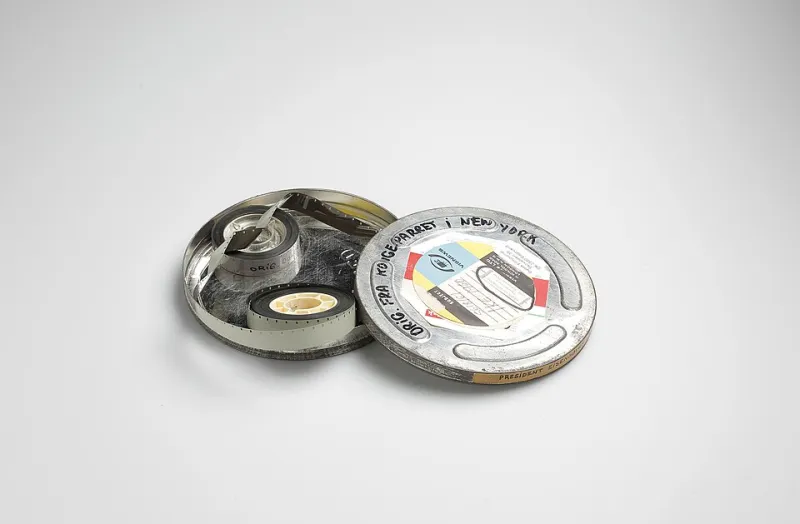
Photo: DRs Kulturarvsprojekt from Copenhagen, Danmark, CC BY-SA 2.0, via Wikimedia Commons
In a converted warehouse in Portland, Oregon, a filmmaker signs the back of a 16mm reel can with a fine-tipped archival pen. The gesture is small, almost private. Yet it marks a quiet shift in how American experimental shorts are being circulated: the film is no longer simply a file or a festival entry. It is copy 4 of 20.
The editioning of short films—numbered runs, signed certificates, hand-assembled USB folios, and one-night-only projection events—has moved from isolated gesture to recognizable practice. In 2026, micro-distributors, festival programmers, and printmakers describe a field testing whether the logic of the limited print can coexist with the avant-garde’s long-held suspicion of scarcity.
A Printmaker’s Logic, Applied to Light
The vocabulary is borrowed directly from relief printing. Filmmakers speak of “striking” an edition, of “artist’s proofs,” of “canceling” a run. A 16mm print may be numbered 1/12 and accompanied by a signed colophon. A digital short may be released as a USB folio—twenty copies, each containing a different insert, a hand-cut title card, a fragment of the optical track. The object is not the film alone; it is the film as an artifact with a ledger.
“We are not inventing a new economy,” said Mara Ellison, who runs a small distribution outfit in Chicago focused on hand-processed shorts. “We are admitting that the old one was already selective. A festival slot is scarce. A grant is scarce. Editioning just makes the scarcity visible and, sometimes, accountable.”
Ellison’s roster includes a nine-minute film available in an edition of fifteen 16mm prints and a separate “projection license” for a single evening. The prints are not for sale to institutions alone; individuals can buy them, though few have projectors. The license is the more common purchase, priced to cover a venue’s screening and a modest fee to the filmmaker.
The Mechanics of Scarcity
The mechanics vary. Some editions are physical: 16mm or Super 8 prints struck from an original camera negative, each inspected and signed. Others are hybrid: a digital master delivered on an encrypted USB drive, paired with a printed booklet and a numbered certificate. A smaller number are “event editions”—the film exists publicly only for one projection, after which the file is withheld or destroyed, and the only remains are a program note and a memory.
At a festival in upstate New York this fall, a programmer scheduled three “editioned” shorts in a single block. Each film was introduced with its edition size and number, as if announcing a print run. The audience received a letterpress program card, numbered. The films have not been made available online.
“The audience is not buying a product,” the programmer said, asking not to be named because the festival’s distribution terms are still being negotiated. “They are witnessing a run. That distinction matters to the filmmakers, and it matters to the room.”
Funding and the Ledger
For filmmakers, the appeal is partly financial. A limited edition can generate income outside the grant-and-festival pipeline. A run of twenty USB folios at $150 each yields $3,000 before costs—modest, but unrestricted. A single 16mm print sale can cover a lab bill. The numbers are small, but so are the budgets.
Printmakers who have advised filmmakers on editioning describe a learning curve. “The first question is always: what are you selling?” said Corinne Vail, a letterpress printer in Providence who has consulted on several short-film editions. “Is it the image, the object, the right to project? Filmmakers often conflate all three. The ones who succeed are precise about what the edition contains.”
Vail’s own involvement began when a filmmaker asked her to print a colophon for a series of hand-processed shorts. She now advises on paper stock, numbering sequences, and the language of certificates. “A print edition has centuries of convention,” she said. “A film edition has about a decade. The conventions are still being invented, which is both the risk and the interest.”
Access and the Democratic Impulse
The tension is not lost on the field. Experimental cinema has long positioned itself against the commodity form—against the idea that a film is a thing to be owned. Editioning, by design, makes ownership explicit. Critics within the community ask whether a numbered run of twenty is a distribution strategy or a retreat from the possibility of broad access.
“I understand the worry,” said a micro-distributor in Los Angeles who asked to speak generally rather than about specific titles. “But the alternative was never universal access. It was a handful of festival screenings and maybe a bad Vimeo link. The edition does not create the scarcity. It formalizes it and sometimes redirects the proceeds.”
Some filmmakers split the difference. A short may be editioned physically while remaining free online after a set period—an embargo model borrowed from publishing. Others release a “reading copy”: a low-resolution version for study, while the editioned object carries the high-resolution master and the projection rights.
The One-Night Stand
The most radical version is the one-night-only projection event. The film is shown once, in a single venue, to a single audience. No recording is permitted. The edition, if there is one, consists of the documentation—a program, a signed poster, a piece of the set—rather than the film itself.
At a micro-cinema in Baltimore, a recent program paired three such events with a printmaker’s stall in the lobby. Visitors could buy a numbered broadside featuring a frame from each film, hand-pulled that afternoon. The films themselves were not for sale. The broadsides sold out.
“The film is the performance,” the curator said. “The print is the residual. That feels honest to the material.”
What an Edition Does to a Film
Editioning does not simply change a film’s market. It changes the film’s social life. A numbered print invites comparison between copies—variation in grain, in splice, in the physical wear of the reel. A USB folio invites collection and cataloging. A one-night event invites memory and hearsay. Each format produces a different kind of attention.
Whether the practice will endure is an open question. The infrastructure is fragile: few labs strike small runs of 16mm, few distributors have the appetite for the paperwork, and few buyers have the equipment. But the editioning turn has already altered the conversation. It has given filmmakers a vocabulary for scarcity that is not purely defensive, and it has given audiences a way to hold experimental cinema at arm’s length and close up at once.
In Portland, the filmmaker caps the pen and places the reel back in its can. Copy 4 of 20 is not a master. It is one of a run, signed, numbered, and destined for a shelf or a projector. The film will travel as films do—through rooms, through hands, through the slight friction of an object that insists on its own limits.

